















If your workshop, warehouse or fabrication unit needs to lift loads safely along a fixed bay, a single girder EOT crane is usually the most economical place to start. EOT stands for Electric Overhead Travelling crane. This guide explains how a single girder EOT crane works, where it fits, how it compares with a double girder crane, and what to check before you buy.
What Is a Single Girder EOT Crane?
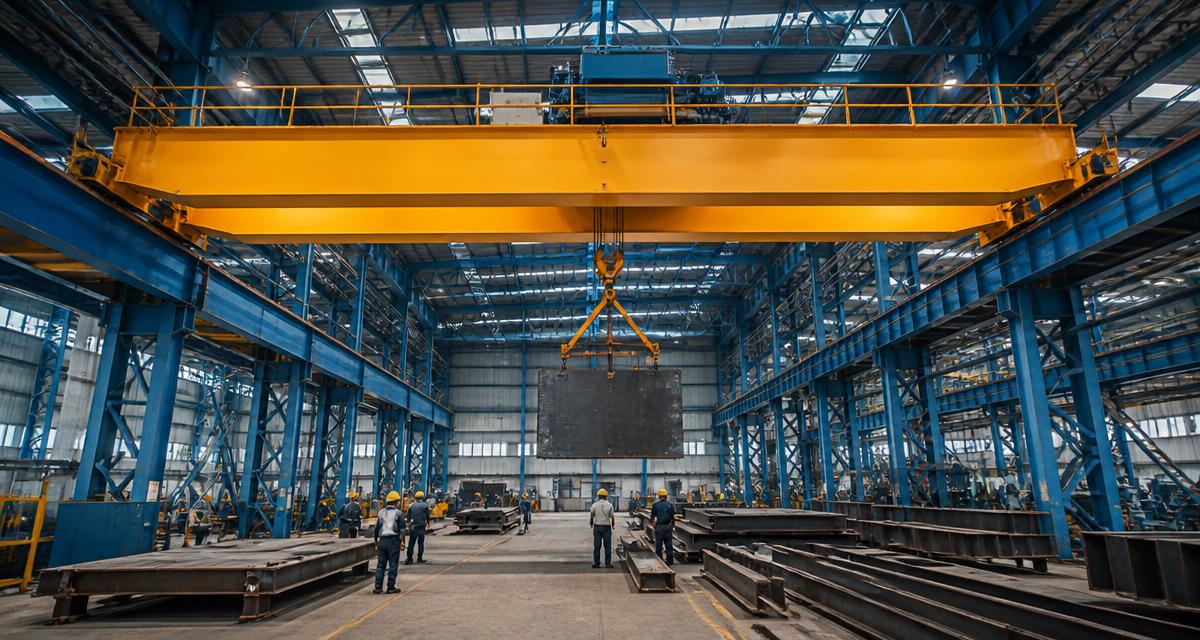
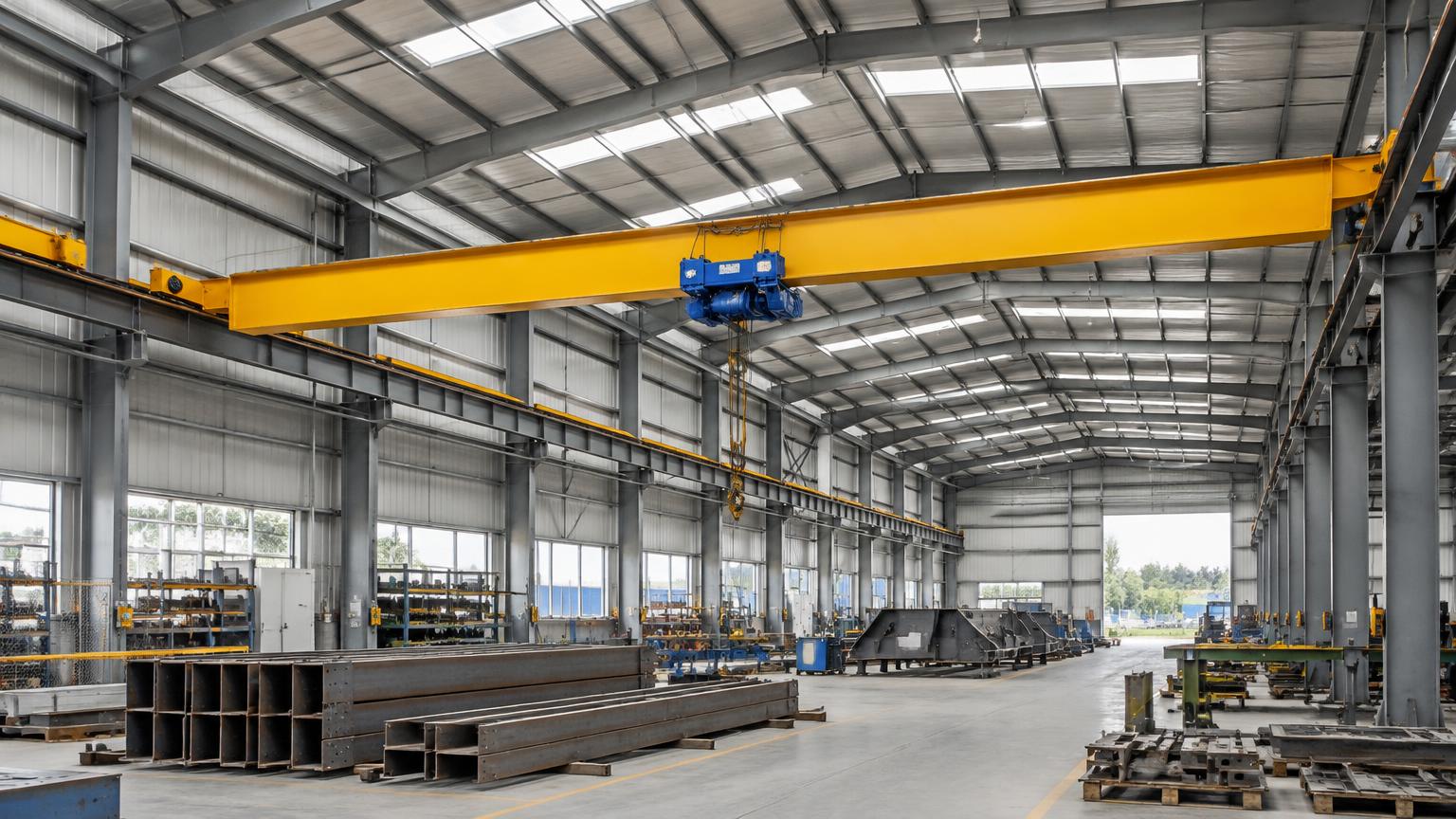
A single girder EOT crane has one main girder (beam) that spans the bay. It runs on rails mounted along the building's side walls or columns. An electric hoist travels along the girder, usually hanging from its bottom flange, and lifts the load.
The crane makes three motions:
- Hoisting: lifting and lowering the load.
- Cross travel (CT): the hoist moving along the girder.
- Long travel (LT): the whole crane moving along the runway rails.
Together these let the operator reach almost any point on the shop floor.
Main Components
- Girder: a rolled steel section (I-beam) or a fabricated box girder, depending on span and capacity.
- End carriages: the wheel assemblies at both ends that carry the girder along the runway.
- Electric hoist: a wire rope or chain hoist with its trolley.
- LT and CT drives: geared motors that move the crane and hoist, often with a VFD for smooth starts and stops.
- Control system: a pendant push-button station, a radio remote, or a cabin.
- Power supply: a DSL bus bar or a festoon cable system.
- Safety devices: limit switches, overload protection, buffers, emergency stop and hooter.
Where Single Girder EOT Cranes Work Best
Single girder cranes suit light-to-medium duty work where headroom and budget matter:
- Fabrication and machine shops
- Warehouses and godowns
- Automobile and auto-component plants
- Foundries and casting units
- Assembly lines and maintenance bays
- Industrial areas such as Okhla, Noida, Faridabad and Gurgaon
They are typically used for capacities from about 1 tonne up to around 10 to 20 tonnes.
Single Girder vs Double Girder EOT Crane
| Factor | Single Girder | Double Girder |
|---|---|---|
| Capacity | Light to medium | Medium to very heavy |
| Span | Short to medium | Medium to long |
| Cost | Lower | Higher |
| Self-weight | Lighter, so lighter runway loading | Heavier, so stronger runway needed |
| Headroom | Needs more of it, since the hoist hangs below the girder | Hoist runs on top, so hook reaches higher |
| Duty cycle | Intermittent to moderate use | Heavy, continuous use |
| Installation | Simpler and faster | More involved |
Rule of thumb: if your loads are moderate, your duty is not continuous, and your building has reasonable headroom, a single girder crane gives you the best value. For heavy loads, long spans or round-the-clock operation, go double girder.
Key Factors That Decide Price
There is no standard price for a single girder EOT crane, because each one is built to your bay. These are the main factors:
- Capacity: 5 t and 10 t cranes differ a lot in girder and hoist size.
- Span: a longer span needs a stronger girder.
- Height of lift: more rope length and a larger drum.
- Duty class: higher classes need heavier components. Cranes in India are classified under IS 3177.
- Speeds: hoisting, CT and LT speeds, and whether you need VFD control.
- Control type: pendant, radio remote or cabin.
- Power feed: DSL bus bar or festoon.
- Site conditions: indoor or outdoor, dusty, or high temperature.
To get an accurate quotation, send us your span, capacity, lift height, duty and runway details.
What to Check Before You Buy
- Building and runway: can your columns and runway beams take the crane's wheel loads?
- Headroom: measure from the runway rail to the roof truss or lowest obstruction.
- Standards: look for design to IS 3177 and proper load testing at handover.
- Safety features: limit switches, overload protection and emergency stop should be standard.
- After-sales support: ask about spares, AMC and breakdown response in your city.
Maintenance Tips
- Inspect wire ropes, hooks and brakes regularly.
- Lubricate gearboxes and wheels on schedule.
- Check limit switches and the emergency stop every week.
- Keep a written log of inspections and repairs.
- Get an annual load test and inspection by a competent person.
A good AMC (Annual Maintenance Contract) prevents most breakdowns and extends crane life.
We supply and support cranes across Delhi NCR, including Delhi, Noida, Gurgaon and Faridabad.
Frequently Asked Questions
What is the maximum capacity of a single girder EOT crane?
Usually up to about 10 to 20 tonnes. Beyond that, a double girder crane is normally more suitable.
What is the difference between EOT and overhead crane?
"Overhead crane" is the general term. "EOT" specifically means the crane is electrically driven, as opposed to hand-operated (HOT) cranes.
Can a single girder crane be used outdoors?
Yes, with weather protection, suitable painting and an outdoor-rated electrical system. Tell us the site conditions when you enquire.
How long does installation take?
It depends on the site, but a standard single girder crane is generally quicker to install than a double girder one.
Do you supply in Delhi NCR?
Yes. We supply and support cranes across Delhi NCR, including Delhi, Noida, Gurgaon and Faridabad.
Get a Single Girder EOT Crane Quote from Linkwel Engineers
Linkwel Engineers has been manufacturing lifting equipment from Okhla Industrial Area, New Delhi, since 1989. We design single girder EOT cranes to your span, capacity and duty requirements, and support them with installation and maintenance.